Rethinking Design Partnerships
At A Place in Childhood (APiC), we believe the future of architecture and landscape design lies in creating places with people, not just for them. Nowhere is this more critical — and more rewarding — than involving children and young people in the development process.
For architecture and landscape practices, partnering with specialists like us unlocks access to a group whose needs, perspectives and creativity often go untapped, yet whose rights and voices are increasingly recognised in policy and law. Our methodologies align seamlessly with the RIBA Plan of Work, meaning co-design doesn’t just fit in — it can elevate your projects.

Co-Design in Early Stages: Setting the Brief Right
Many of the most influential decisions on a project happen early — during strategic definition and preparation and brief. Here, our How To Guide for Co-creating Local Neighbourhood Plans with Children and Teenagers offers a clear, structured approach to unlock young people’s insights.
We help you:
- Understand the lived experience of local places from a youth perspective
- Identify key assets and barriers in the environment through walking tours and experiential mapping
- Pinpoint early opportunities and risks that might otherwise be overlooked
This deep contextual knowledge can transform your baseline studies, site analyses, and concept development. For instance, our work in Shetland supported new paths and community projects, driven by insights from local young people — now influencing planning decisions and Local Place Plans.
The process of co-creating a plan takes one full school day with a cohort of young people, and then the level of write-up required is dependent on your project goals. At minimum, it is a Map, and set of Priorities for Action. It is important to factor in at least a month for contacting schools and working out details, but given enough notice and support to make it happen, schools are receptive to seeing the value for them and their pupils.
Stages 2 and 3: Concept and Spatial Design through the Co-Design Process
As projects move into concept design and developed design, the stakes rise. It’s not just about identifying what’s wrong, but envisioning what’s possible. Our Co-Design Process brings structure and creativity to this stage. This follows four stages:
- Setting the Scene
- Determining Principles
- Exploring Possibilities
- Prototyping
The stages are designed to feed into one another, and deepen young people’s learning around their environment as well as support a design proposal.
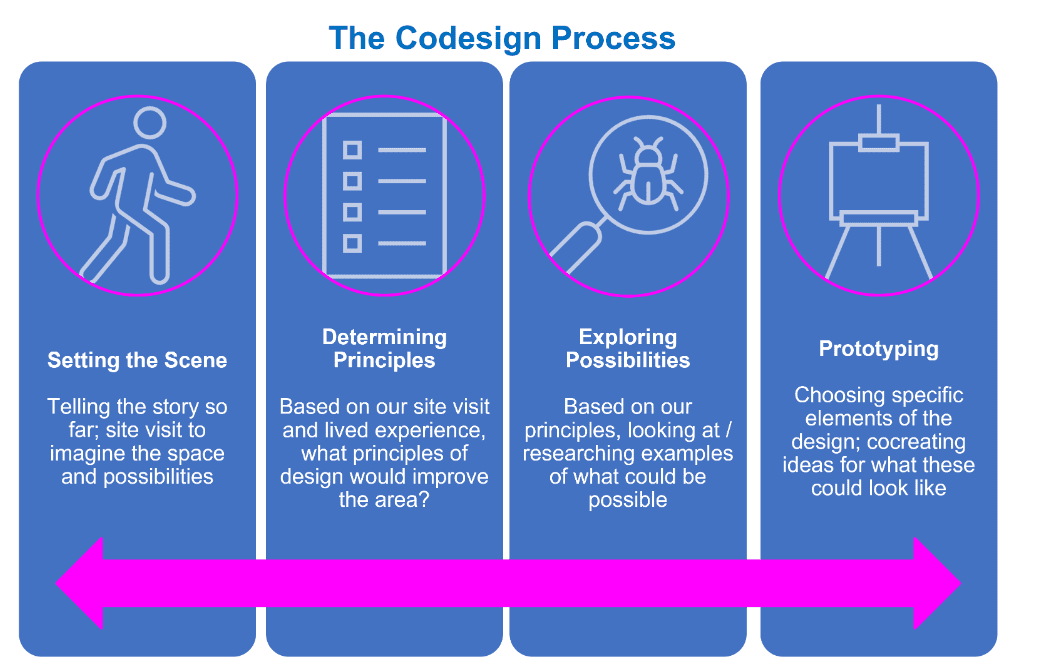
These stages can be adapted to project need and any age group or setting. If you have already involved local young people in Stage 0 or 1, then you need not spend so much time setting the scene. This work can take place in multiple sessions, or across the course of one full school day. A write-up will include the design principles and images and descriptions of the prototypes the young people have come up with. This write-up will usually take 0.5 to 1 day of work per session, depending on project goals.
The Spectrum of Co-Design: Tailoring Involvement
Of course, not every project — or client — requires the same level of participation. That’s why we also use our Spectrum of Meaningful Co-Design to guide how deeply children and teenagers are involved.
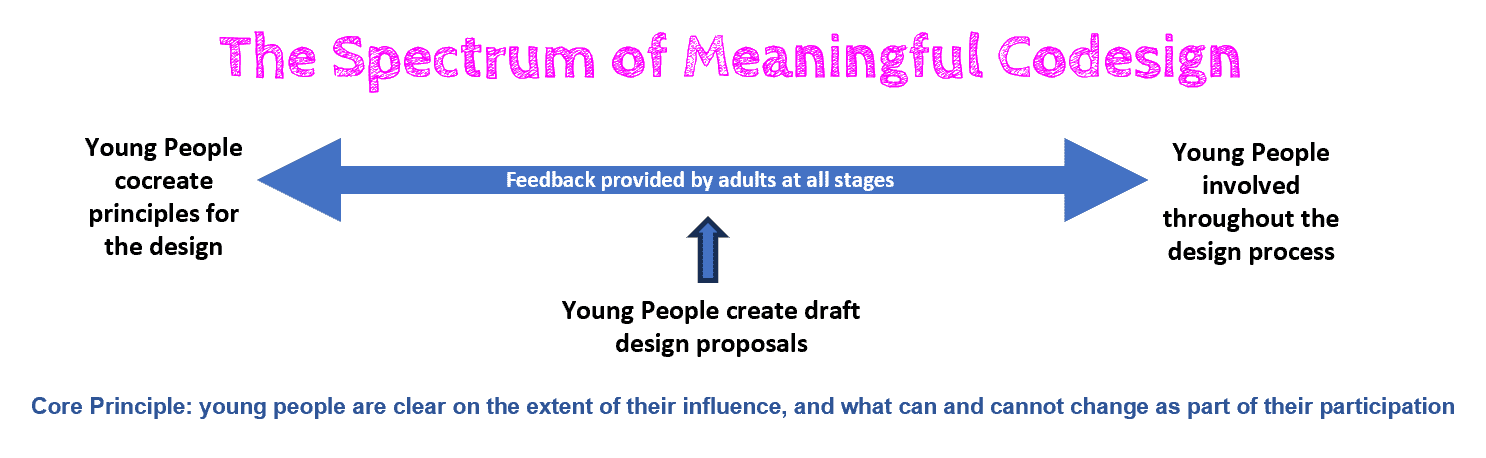
The spectrum ranges from:
- Cocreating design principles that will be used by adult designers
- Collaborating with designers to draft proposals
- Child/Youth-Led design, where young people are engaged in an ongoing discussion across the design process
We tailor our approach to each brief, budget and timeline. But across all levels, our projects show how meaningful youth participation can elevate design.
Our Co-Design in Action: Real Examples Across the RIBA Stages
Digital Urban Design
- Glasgow (Minecraft) — Flourishing Molendinar, with Sustrans Scotland
We supported children from St Philomena’s Primary, including the Enhanced Nurture Provision unit, in redesigning public spaces as part of wider infrastructure changes. Rather than merely responding to adult proposals, pupils led the design process using a detailed Minecraft model of their neighbourhood. Their ideas fed directly into the ‘Flourishing Molendinar’ Places for Everyone scheme. The project won the National Transport Award and the Learning for Sustainability Award and demonstrated a replicable, digitally enabled model for child-led urban design. Read more here.
Community Spaces
- NEAT Connections, North Edinburgh
Teenagers from Craigroyston Community High School spent 2½ days co-designing improvements to Pennywell Road. They explored safety, belonging, and placemaking through Minecraft, art, and real-world planning exercises. Their proposals — including sensory gardens and a “Forth Bridge” Park — addressed anti-social behaviour through care and co-responsibility. AECOM joined the final session, helping integrate proposals into the broader NEAT Connections plan. Read more here.
- Art Park, Craigmillar, Edinburgh
Art Park was co-designed with over 70 children and teenagers in Craigmillar, transforming a forgotten green space into a vibrant public art and nature park. Funded by Paths for All and supported by City of Edinburgh Council, NHS Lothian, and the Scottish Violence Reduction Unit, the project arose from a Cocreated Children and Teenagers’ Neighbourhood Plan, where young people expressed a desire for more creative, welcoming public spaces. The park will blend public art, nature play, and wildflower planting.
Inclusive Urban Design
- Liveable Neighbourhoods, Glasgow
During RIBA Stage 2, we delivered full-day workshops in six Glasgow schools, working alongside Make Space for Girls, Collective Architecture, Arcadis, and Glasgow City Council. Young people developed design principles and early ideas for neighbourhood improvements, focusing on safety, inclusion, active travel, and feminist planning principles. Their lived experience is now shaping the next stage of design deliberations. Read more here. - Leith Links, Edinburgh
In May 2024, we facilitated a half-day workshop with girls and non-binary young people, exploring how public parks can better meet their needs. Insights focused on safety, inclusion, and belonging — going beyond traditional sport-based designs. Their input is directly shaping final plans for Leith Links, helping create more inclusive and welcoming spaces. Read more here.
Linking Co-Design to RIBA Outcomes and Client Value
Integrating young people’s perspectives isn’t just ethically and legally the right thing to do — it’s good business. Co-design can help achieve:
- Better alignment with planning and design policy, as well as the UN Convention on the Rights of the Child
- Early de-risking of contentious issues that can otherwise stall projects at planning stages
- Designs that genuinely serve multi-generational needs, enhancing community resilience and client reputation
- Demonstrable social value — increasingly a key criterion in public procurement
Let’s Collaborate
Whether you’re an architect, urban designer or landscape architect, we’d love to help bring young people’s voices into your projects. We can plug into your workflow at any RIBA stage, offering:
- Training and capacity building for your teams
- Joint workshops for co-creation and co-design
- Ongoing partnership through design development and stakeholder engagement
Reach out to Dr Jenny Wood at jenny.wood@aplaceinchildhood.org to explore how we can co-create the next generation of inspiring places — together.