
Why Local Development Plans Must Include Children and Young People
In Scotland, local planning authorities are now legally required to engage children and young people in preparing their Local Development Plans (LDPs). Under the Planning (Scotland) Act 2019, every planning authority must prepare a Play Sufficiency Assessment (PSA) as part of the Evidence Report and engage with children and young people during the development of the LDP.
These duties are reinforced by the National Planning Framework 4 (NPF4) and its guidance on effective community engagement. Planning Circular 1/2022 on Local Place Plans (LPPs) also clearly states that engagement must be inclusive and creative, with particular attention to children, young people and seldom-heard groups.
What the Law Requires
- Play Sufficiency Assessments (PSAs): Required as part of the Evidence Report (s.16D of the Act), these must assess the sufficiency of play opportunities in the local authority area.
- Early engagement: Section 16C requires early engagement in preparing the Evidence Report.
- Engagement on the Draft Plan: Authorities must consult on the proposed LDP (s.18), again ensuring engagement is inclusive and accessible.
These requirements are underpinned by the UN Convention on the Rights of the Child (UNCRC), recently incorporated into Scots Law through the UNCRC Incorporation (Scotland) Act 2024.
Children’s Rights in Planning
Planning touches on many rights:
- Article 12: The right to express views freely in matters affecting them.
- Article 15: The right to meet and form groups, including to influence decisions.
- Article 31: The right to play, rest and leisure.
- As well as Articles 24 and 27 (health, environment, and standard of living), and Article 29 (education supporting understanding of society and the environment).
These aren’t just rights to tick off. Involving children and young people meaningfully enhances social, environmental, and economic sustainability. It leads to more inclusive places and helps ensure planning decisions work for all generations.
A Mindset Shift: From Teaching to Listening
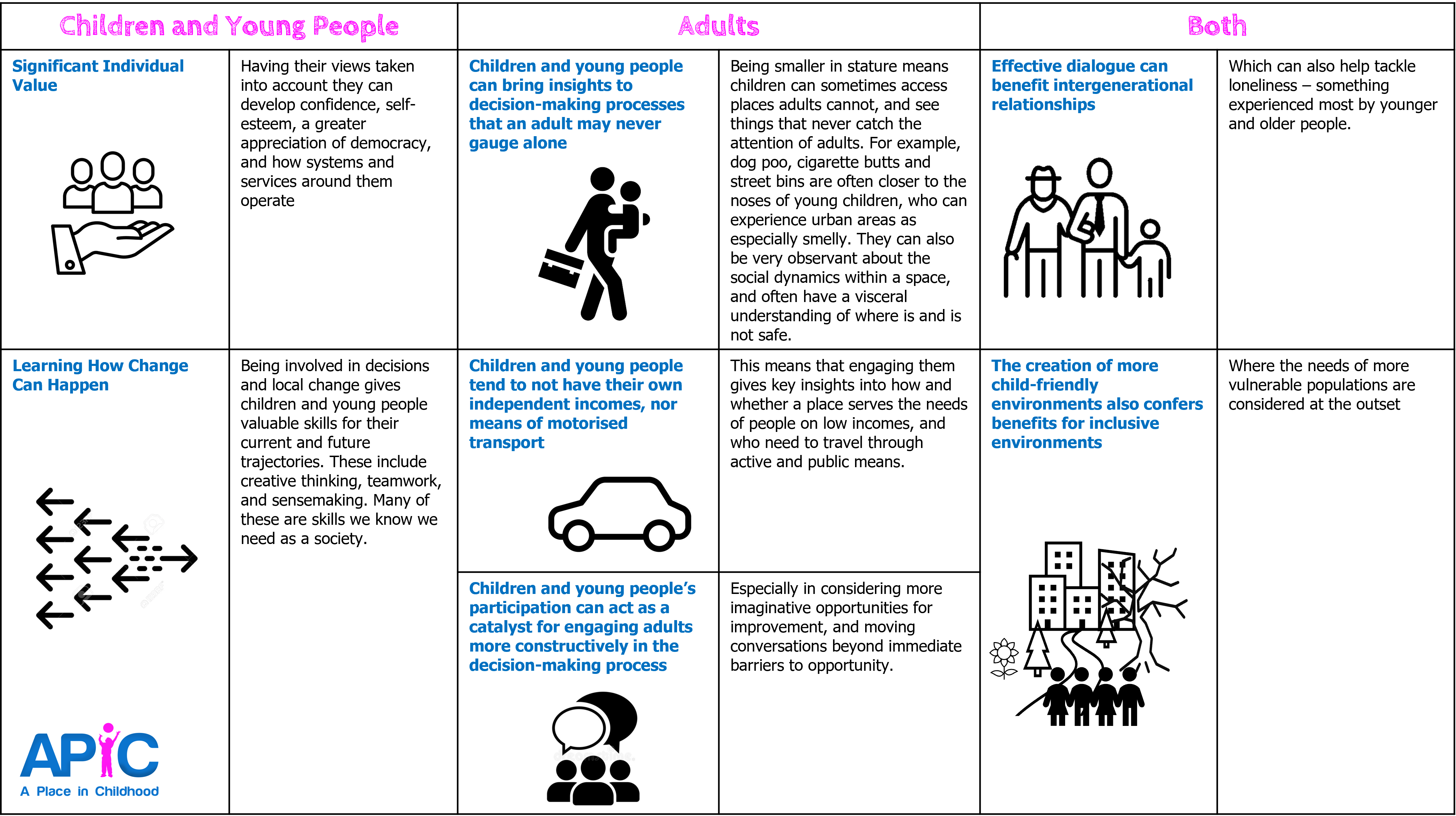
A common pitfall in engaging children and young people is assuming the role is primarily to educate them about planning. While some contextual learning is helpful, the real objective is to support them to give their views. Education will happen organically through participation. The focus should remain on listening, understanding, and incorporating what they have to say into plans.
This approach also helps professionals grow in their understanding of how children and young people use and experience local environments – an essential foundation for inclusive place-making.
Meaningful Engagement in Play Sufficiency Assessments
The first formal opportunity to engage is in preparing the PSA. Many authorities begin with surveys, and these have value for gathering some insights. But they also have limitations: low response rates, inaccessible language, difficulty reaching younger children, and limited capacity for participants to explain priorities or reasoning.
Several local authorities have gone further:
- Glasgow City Council has piloted a codesign model involving children in mapping play experiences and shaping interventions.
- East Lothian Council partnered with Play Scotland to engage in extensive assessment of all space, and prioritise hearing from groups known to be marginalised in play such as children with Additional Support Needs, and young women and girls.
- Falkirk Council included our work on child- and youth-led experiential mapping and priority-setting in North Falkirk and Denny/Bonnybridge, using creative tools like walking tours and collective mapping.
The key is to aim for depth over breadth if resources are tight. Over time, further gaps can be filled through further targeted engagement. Indeed, when it comes to conducting a new PSA, new engagement can build upon the old rather than replicate it if it is of high quality to begin with.
A strategic approach might involve:
- Direct engagement with groups whose voices are typically underrepresented.
- Focusing on communities with known or likely play insufficiencies.
- Using a consistent and rights-based methodology, such as that outlined in our How To Guide on Cocreating Neighbourhood Plans with Children and Teenagers.
These approaches deliver insights not only on play but on the broader lived experiences of children and young people in their neighbourhoods. The resulting knowledge can meaningfully shape the Evidence Report and provide a strong foundation for policy direction.
Engaging on the Proposed Plan
Engagement shouldn’t stop with the Evidence Report. The draft LDP offers another vital opportunity to gather insights. Again, strategic sampling can help target children and young people in areas affected by proposed changes, or identity groups whose voices matter for specific topics.
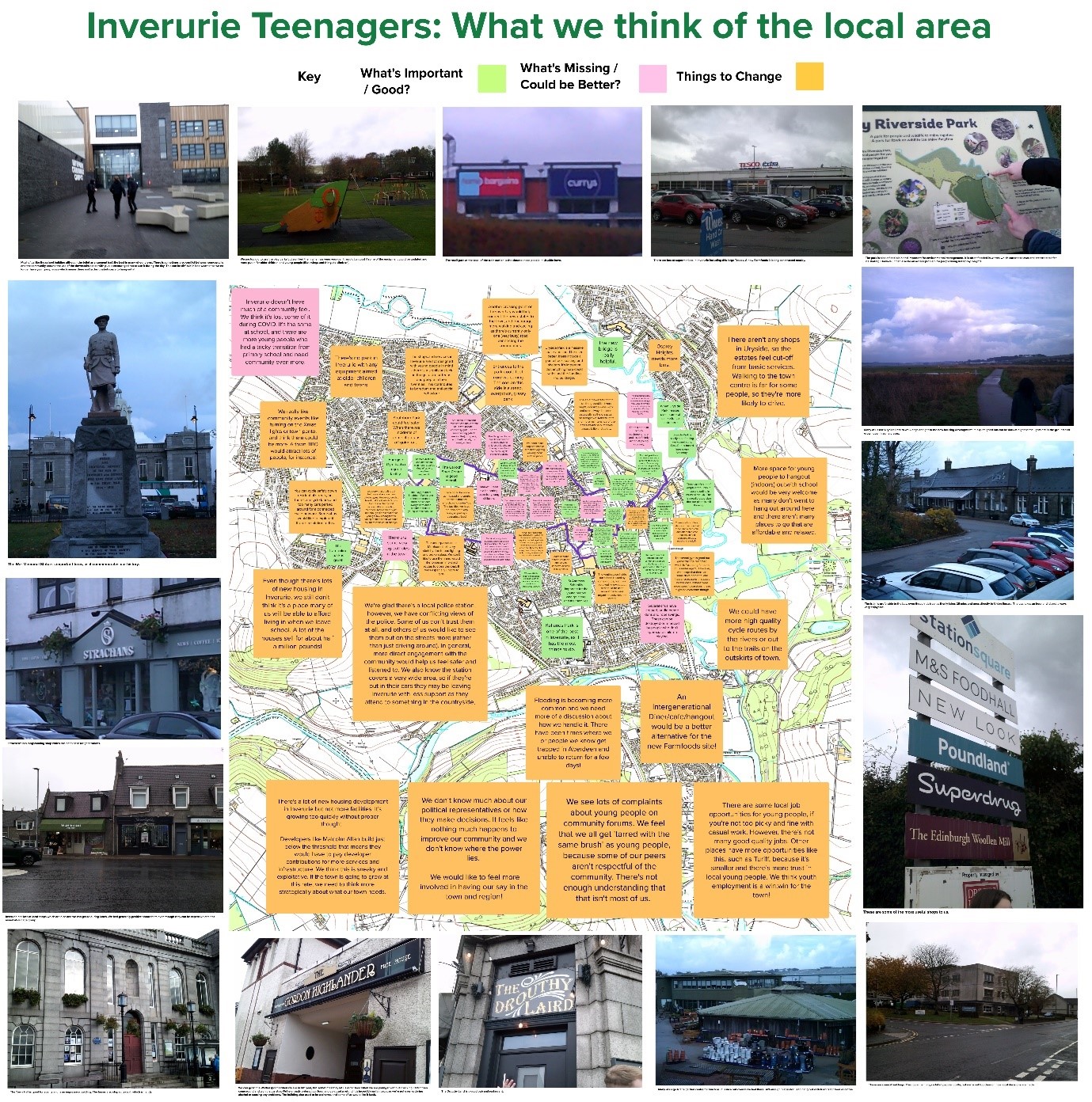
The experiential mapping and Island Task from APiC’s How To Guide are ideal tools. These help children and young people reflect on their neighbourhoods, articulate a vision for the future, and collectively determine priorities for action.
Engagement can be:
- Area-specific: for proposed developments, zoning changes, or infrastructure upgrades.
- Thematic: for example, on greenspace, active travel, affordable housing or local services.
- Strategic: inviting young people to co-create a vision for the area that aligns with the LDP’s overall strategy.
This isn’t just good practice – it’s an opportunity to connect children and young people with the big questions facing their communities, and to ensure that the LDP is grounded in their lived experience.
Local Place Plans: A Foundation for Participation and Policy
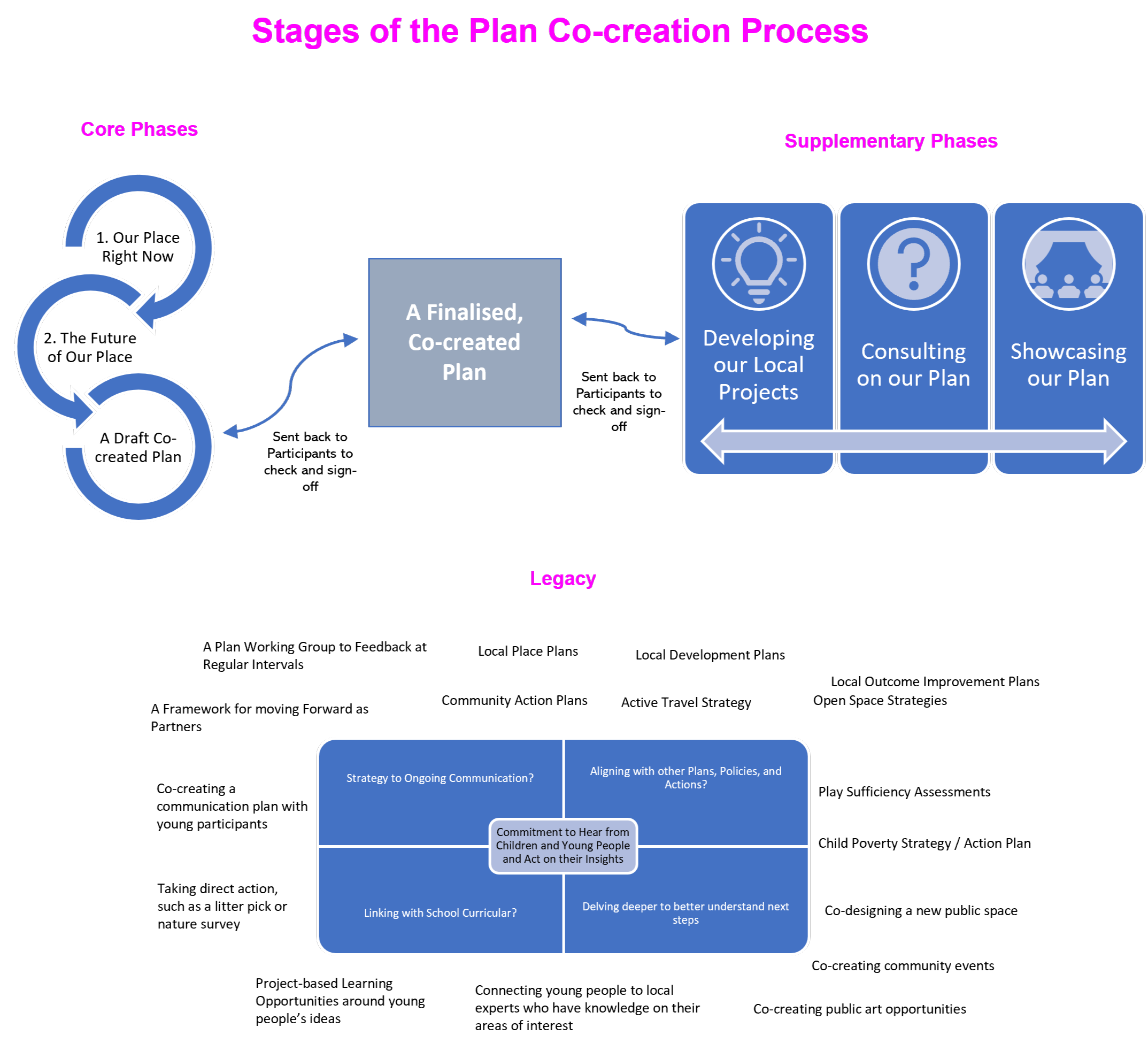
The co-creation processes described here are not only ideal for the statutory planning process, but also form a powerful starting point for Local Place Plans (LPPs). When communities work with children and young people to develop a Local Place Plan, the outputs can directly inform the PSA and Evidence Report. This joined-up approach creates efficiency and consistency in how local voices shape policy.
For example, Jedburgh used a full co-creation process guided by APiC’s methodology. Their children and young people developed a local plan that informed the wider LPP, as well as influencing the statutory planning process more broadly.
Beyond planning, the outputs of a thorough co-creation process can also inform Community Action Plans, Active Travel strategies, and other local interventions such as new path proposals.
At APiC, we’ve also seen the creative legacy of this work in projects like:
- A Children’s Neighbourhood Festival in Falkirk
- An Art Park initiative in Edinburgh
These projects demonstrate how child and youth participation can not only meet statutory duties, but spark new ideas and strengthen community identity.
Final Thoughts: From Compliance to Opportunity
Too often, legal duties are seen as boxes to tick. But engaging children and young people meaningfully in Local Development Plans is about more than compliance. It’s a chance to deliver better planning: more rooted in lived experience, more inclusive, and more likely to deliver sustainable outcomes. An example of how wide-ranging and impactful this work can be is Shetland’s Westside Children and Teenager’s Plan.
At A Place in Childhood, we support planning authorities to meet and exceed their statutory duties through developmentally appropriate, rights-based, and place-focused engagement.
Interested in training or support? Contact us at jenny.wood@aplaceinchildhood.org to discuss how we can help embed meaningful participation in your LDP process.